
Between Forests and Oceans: Reflections on your surroundings as creative inspiration
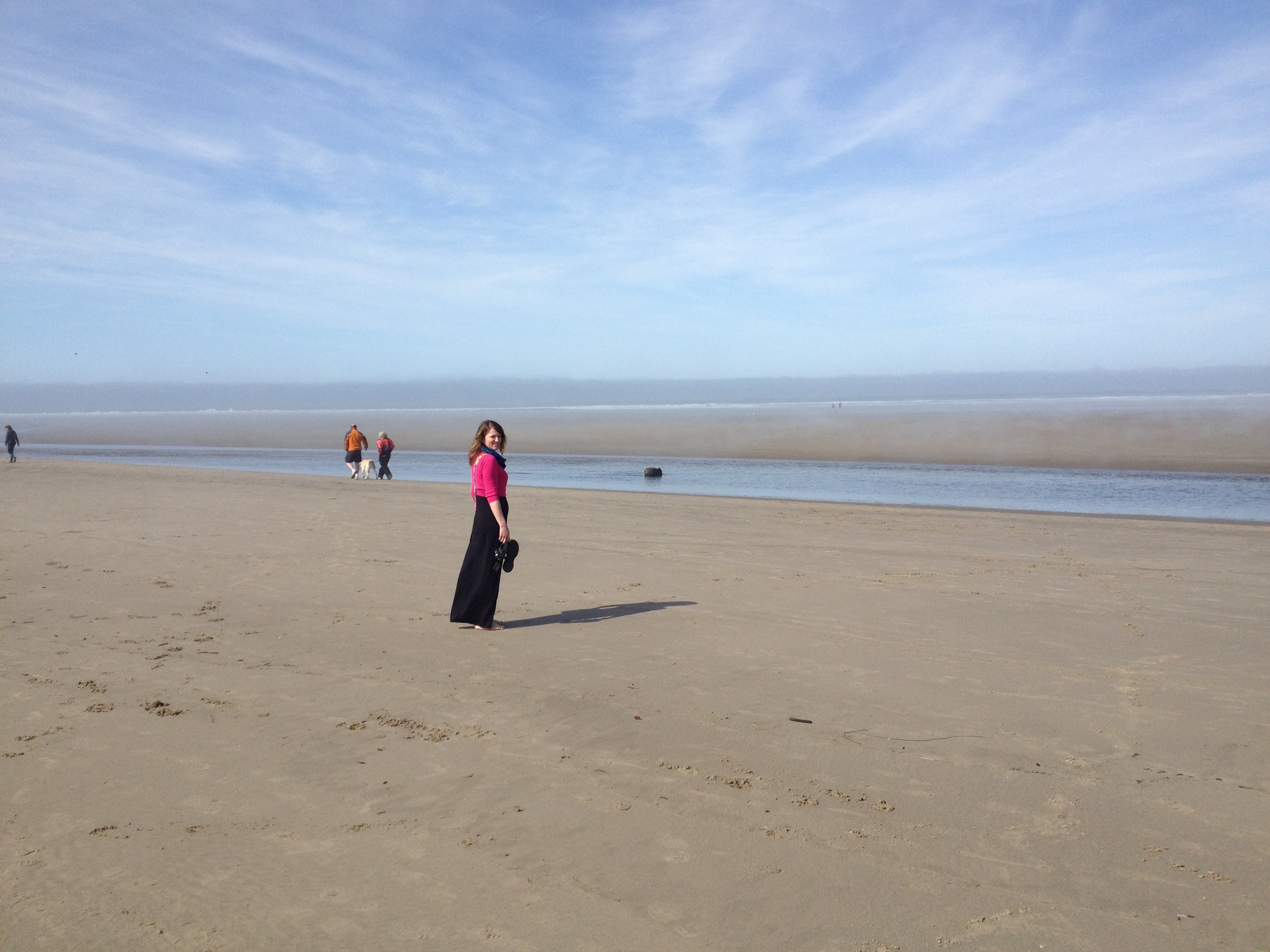
Katie Brower-Wojda at Cannon Beach, Oregon
When I sit down to stitch, I often find myself listening before I begin. On the Oregon coast, the sounds are layered — the steady crash of waves, the quiet rush of wind moving through evergreens, the soft calls of gulls overhead, the sounds of dogs chasing and barking one another down the beach. These rhythms have become part of my stitching, almost like an invisible metronome guiding each needle’s rise and fall.
Sashiko, in its Japanese origin, was born from necessity. At its simplest, it is a way to strengthen cloth and extend its life, but it also reflects the landscapes of where it grew: the mountains, fields, and coastlines of rural Japan. Patterns often echo rippling water, rice fields, or the stars above. I find comfort in knowing that place was always stitched into practice.
Here, surrounded by the Pacific Northwest, I’ve started to notice how environment shapes my own approach. The deep greens of moss and forest canopy, the shifting grays of ocean fog, the curve of driftwood and tide pools — they all find their way into how I see the cloth. Even when I’m working a traditional motif, I’m aware of the way this coastline colors my imagination.
To stitch in Oregon is to live in conversation with both abundance and impermanence: trees that tower for centuries, storms that shift shorelines overnight, fires that reset the landscape. Each stitch feels like a small gesture of acknowledgment as a way to notice, to respond, and to connect.
I often think of sashiko as a thread between places. The Pacific Ocean is not just a distance to be crossed but also a shared horizon. On one side, Japanese artisans continue to carry this practice forward. On the other, I sit with needle in hand, learning slowly, honoring their guidance, and allowing the Oregon landscape to shape the rhythm of my practice.
In this way, sashiko becomes more than technique. It becomes a way of belonging…to fabric, to community, and to the places that hold us. Between forests and oceans, each stitch feels like a quiet conversation with the world around me.